SpectraLoRA: Physics-Aware Fine-Tuning for Geospatial Foundation Models



SpectraLoRA is a specialized Parameter-Efficient Fine-Tuning (PEFT) library designed for multispectral satellite imagery. Unlike standard LoRA, which treats all input channels equally, SpectraLoRA introduces a Physics-Aware Gating Mechanism that dynamically routes information to specialized adapters based on the spectral signature of the terrain (e.g., Vegetation, Water, Urban).
This architecture is designed to fine-tune massive Geospatial Foundation Models (like IBM/NASA Prithvi-100M) on consumer hardware while enforcing physical consistency in predictions.
🏗️ System Architecture
SpectraLoRA operates as a "Sidecar" to the frozen foundation model. It intercepts data flow to inject physics context without altering the pre-trained weights.
Key Innovations
- Spectral Fingerprinting: Calculates real-time physics indices (NDVI, NDWI, BSI) before the model runs.
- Mixture-of-Experts (MoE): A bank of specialized Low-Rank Adapters (e.g., one for forests, one for cities).
- Dynamic Gating: A lightweight router that blends adapters based on the material properties of the image patch.
- Built-in MLOps Tracking: Automatically logs hyperparameters, training loss, and GeoAI-specific metrics (mIoU, Physics Violations) to local SQLite or enterprise PostgreSQL databases.
- Geospatial Data Catalog: Leverages PostGIS to ingest, index, and dynamically filter satellite chips using precise Earth coordinates (EPSG:4326) directly within the PyTorch training loop.
🖼️ Visualizing Results
SpectraLoRA is built to handle highly diverse, complex geographies—from arid deserts to dense coastal urban infrastructure. The library includes built-in batch prediction tools to visualize the AI's 4-class segmentation (Barren, Vegetation, Water, Urban) side-by-side with true-color satellite imagery.
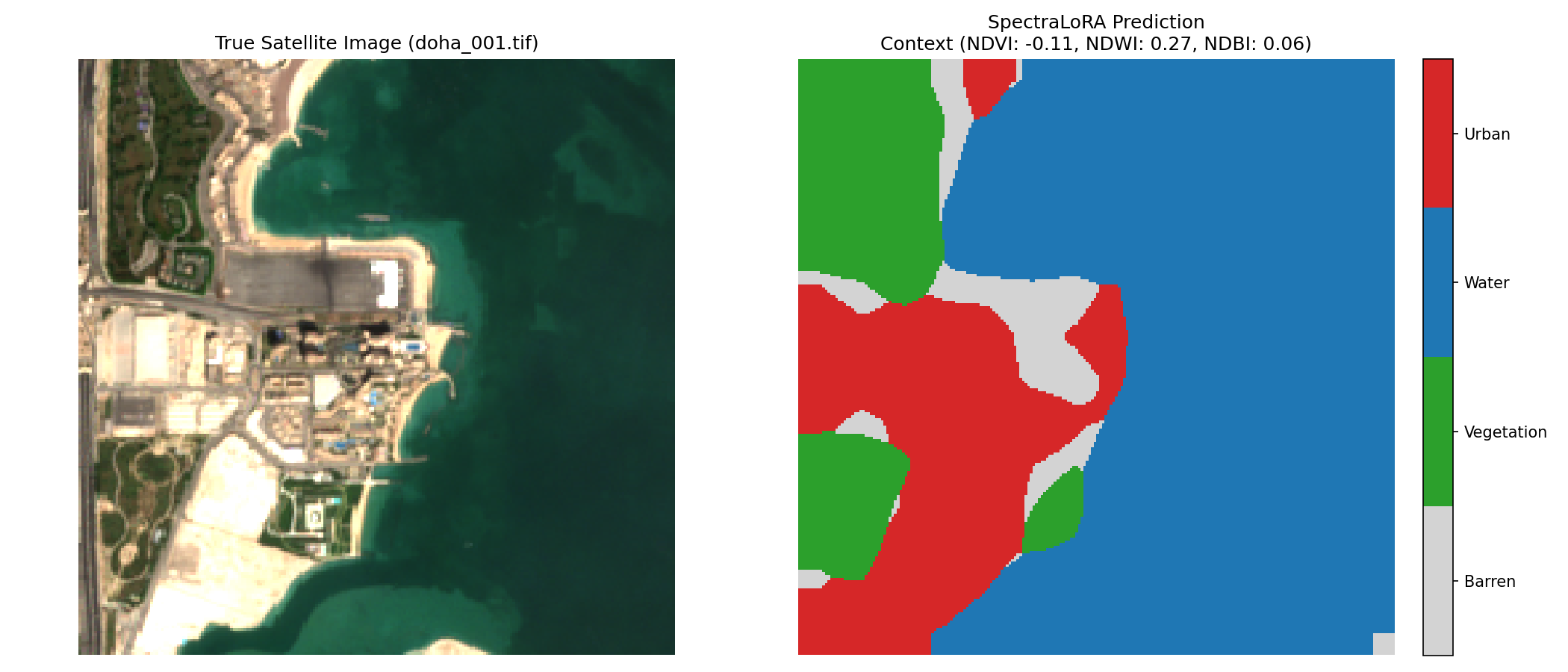 (Example output showing true RGB imagery alongside the SpectraLoRA physics-routed prediction)
📂 Project Structure
SpectraLoRA/
├── spectra_lora/               # The Core Library Package
│   ├── __init__.py             # API Exporter
│   ├── config.py               # Phase 1: Global Configuration & Band Maps
│   ├── spectral_ops.py         # Phase 1: The Physics Engine (NDVI/BSI Math)
│   ├── gating_network.py       # Phase 2: The Neural Router (MLP)
│   ├── layers.py               # Phase 2: The Custom SpectraLoRALayer
│   ├── model_wrapper.py        # Phase 3: The Surgeon (Model Loader & Injector)
│   └── utils.py                # Helpers: GeoTIFF Loading & Visualization
│
├── experiments/                # Execution Scripts & Testing
│   ├── train.py                # Phase 4: Training Loop & Context Patching
│   ├── evaluate.py             # Phase 4: Physics-Aware Evaluation Metrics
│   ├── predict.py              # Phase 5: Batch Inference & Visualization tool
│   └── predictions_output/     # Saved side-by-side RGB vs AI prediction plots
│
├── setup.py                    # PyPI Installation Configuration
├── requirements.txt            # Dependencies
├── LICENSE                     # MIT License
└── README.md                   # This file
🚀 Quick Start
Installation
You can install the library directly via pip:
pip install spectralora
(Alternatively, clone the repository and run pip install -r requirements.txt for development).
Usage (Python API)
Use SpectraLoRA to upgrade a standard Prithvi model with physics-aware adapters:
from spectra_lora import load_prithvi_model, inject_spectra_lora

# 1. Load the frozen Foundation Model (Prithvi-100M)
model = load_prithvi_model()

# 2. Perform Surgery: Inject SpectraLoRA layers
model = inject_spectra_lora(model)

# 3. The model is now ready for training!
# Only the adapter parameters (approx 1-5%) are trainable.
📖 Detailed File Guide
1. The Physics Core (spectra_lora/)
spectral_ops.py: The mathematical heart of the library. It takes raw satellite tensors and calculates 5 physics indices: NDVI (Vegetation), SAVI (Soil-Adjusted Vegetation), NDWI (Water), NDBI (Built-up), and BSI (Bare Soil). This ensures the model "sees" physics, not just pixels.config.py: The blueprint. Defines the Band Map (Blue=0, NIR=3, etc.) to ensure calculations are accurate for the Prithvi model. It also sets LoRA hyperparameters (Rank=4, Alpha=8).utils.py: Handles the messy parts of Geospatial AI. Containsload_geotiffto normalize 16-bit satellite data into float32 tensors, and visualization tools to debug the spectral fingerprint.
2. The Neural Architecture (spectra_lora/)
gating_network.py: A tiny Multi-Layer Perceptron (MLP). It takes the 5-dimensional physics vector fromspectral_opsand outputs soft mixing weights (e.g.,[0.8, 0.1, 0.1]) to control the adapters.layers.py: The custom PyTorch module. It replaces standard Linear layers. It contains:- The Frozen original weights.
- The Adapter Bank (3 parallel LoRA experts).
- The Gating Network.
- Logic: \(Output = Frozen(x) + \sum_{i} (Gate_i(z) \cdot Adapter_i(x))\)
3. The Integration (spectra_lora/)
model_wrapper.py: The "Surgeon." It downloads the Prithvi architecture code dynamically from Hugging Face (since it's not in standardtransformers), loads the weights, and recursively swaps Attention layers withSpectraLoRALayer.__init__.py: Exposes the high-level API so you can import functions cleanly.db.py: The MLOps database engine. Utilizes SQLAlchemy to auto-generate tracking schemas and securely log experiment data without forcing users to write manual SQL.ingest.py: The Spatial Crawler. Automatically extracts geographic bounding boxes and metadata (like cloud cover) from raw.tiffiles and populates the PostGIS spatial catalog.
4. Experiments (experiments/)
train.py: The training engine. It includes a critical Runtime Patch (patch_model_for_context) that allows the model to access the global "Physics Context" without rewriting the original Prithvi code.evaluate.py: A custom validator. Beyond standard mIoU, it calculates a "Physics Violation Score"—counting how many times the model predicted "Vegetation" in a pixel where the NDVI was clearly "Desert."predict.py: A batch-processing visualization tool that iterates through.tifdatasets and outputs RGB-vs-Prediction maps.
📊 Citation
If you use this code for your research, please cite:
@software{spectralora2026,
  author = {Munieb Abdelrahman},
  title = {SpectraLoRA: Band-Specific Low-Rank Adaptation for Geospatial Foundation Models},
  year = {2026},
  url = {[https://github.com/MuniebA/SpectraLoRA](https://github.com/MuniebA/SpectraLoRA)}
}